
By Philder Odanga
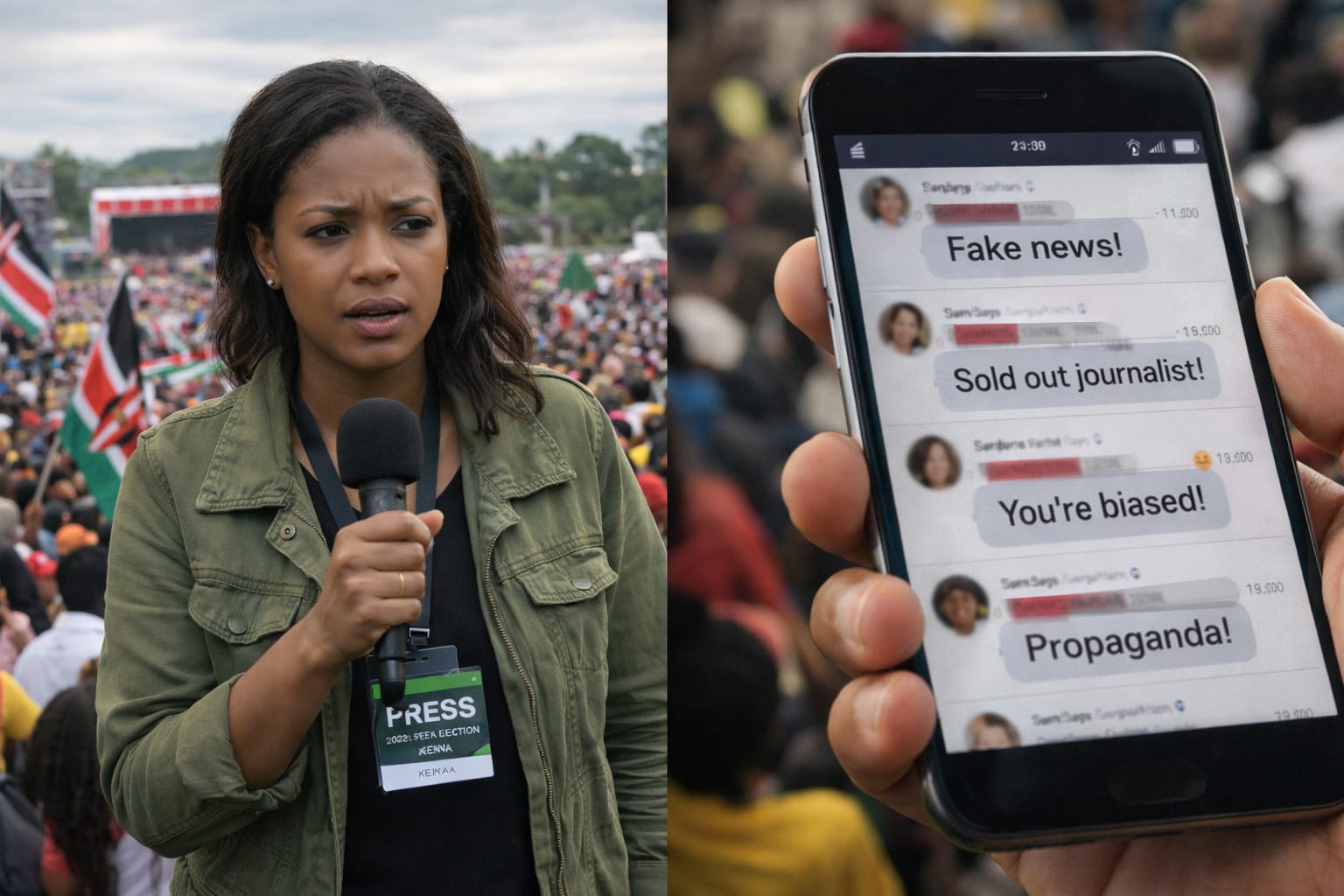
As Kenya went to the polls during the 2022 General Election, journalists were on the front line of informing the public in a highly charged political environment. Alongside the physical risks of election coverage, another threat emerged quietly but persistently: online harassment, misinformation, and coordinated digital attacks targeting journalists, particularly women.
According to the Media Council of Kenya (MCK), at least 43 journalists experienced harassment during the election period. While some incidents occurred in the field, a significant number played out on social media platforms, where journalists covering campaigns, voting, and results were accused of bias, misinformation, and political alignment.
This story applies digital verification skills acquired through training by the International Association of Women in Radio and Television – Kenya ( IAWRT) to examine whether these online attacks reflected genuine public opinion or coordinated efforts to undermine journalism during a critical democratic moment.
During key moments of the election period, including campaign rallies and the announcement of presidential results, journalists who shared updates and analysis on X (formerly Twitter) faced a surge of hostile posts. The dominant claim pushed online was that the media was “working for politicians” and deliberately misleading voters.
Hashtags attacking journalists and media houses trended for hours, accompanied by screenshots, edited clips, and emotionally charged language. At face value, the volume of posts suggested widespread public anger. Verification, however, required a closer look.
Election-related posts attacking journalists were monitored over a 48-hour period following major election developments. Analysis of the posts revealed notable patterns. Multiple accounts shared identical or near-identical captions, reused the same images, and posted within short time intervals.
AI-assisted text comparison tools helped highlight repeated phrasing and coordinated timing across accounts. While the tools did not determine intent or truth, they made visible similarities that warranted deeper human-led verification.
Further checks on several accounts pushing the attacks raised red flags. Many profiles had been created recently and showed little activity beyond election-related posts. Some accounts had no personal information, no interaction with followers, and no presence on other social media platforms.
Reverse image searches on selected profile photos revealed that some images had appeared elsewhere online, unrelated to Kenyan elections or journalism. One image was flagged by an AI image analysis tool as likely AI-generated, suggesting the account may not represent a real individual.
These indicators pointed to possible coordinated amplification rather than spontaneous political expression.
While journalists across the board faced online hostility, women journalists experienced a distinct form of attack. Many posts focused on their appearance, character, and personal lives instead of engaging with the substance of their reporting.
Media monitoring reports and research on online harassment in Kenya have consistently shown that women journalists are more likely to face gendered abuse, especially during elections. Such attacks aim not only to discredit individual reporters but also to discourage women from participating in political journalism altogether.
Insights from digital safety and verification sessions conducted under IAWRT training highlight how gendered disinformation intensifies during elections, when trust, credibility, and public perception are at stake.
No single tool provided definitive proof. Verification relied on a structured process: identifying the claim, analyzing posting patterns, checking account authenticity, verifying images, and applying editorial judgment. AI tools supported the work by speeding up comparisons and flagging anomalies, but conclusions were reached through careful human verification and cross-checking with trusted sources.
The findings align with broader conclusions by media watchdogs that online harassment of journalists during Kenya’s 2022 elections was, in some cases, amplified through coordinated digital behavior rather than organic public debate.
Defending journalism during elections
Elections are a test of democratic institutions, and journalism plays a central role in ensuring transparency and accountability. At the same time, journalists increasingly face digital threats designed to erode trust in their work and silence critical voices.
Trainings by organizations such as the International Association of Women in Radio and Television Kenya (IAWRT) equips journalists with practical skills to verify online content, recognize manipulation, and protect their professional integrity in hostile digital spaces.
As misinformation tactics continue to evolve, strong verification practices remain essential not only to safeguard journalism, but also to protect the public’s right to accurate information during elections.
Share this story
Are you a woman working in media?
Join IAWRT Kenya for training, mentorship, fellowships and a supportive network of women media practitioners.
More stories
- All Posts
- Articles
- Mentorship
- Networking

Home › Blog › Articles Protecting Journalists in Kenya’s Digital Space: Why Media and Tech Policy Must Be Rights-Based 18 October 2026...
Home › Blog › Articles Reporting Violations Against Female Journalists: A Shared Responsibility 31 August 2026 4 min read Articles By IAWRT...
Home › Blog › Articles What a Year of Tracking and Mapping Online Gender-Based Violence Against Women in Media Revealed 24 August...