By Lenser Loise
If you had asked me during our first podcast production coaching session with Irene Mbaya from DW Akademie what my vision for the project was, I probably would not have said that we would go on to produce and publish a complete six-part podcast season.
But that is exactly what we did. So how did we get here?
The idea for the Connected Voices Podcast grew out of research led by the International Association of Women in Radio and Television (IAWRT) and the Association for Progressive Communications (APC) on community networks. As a team, we realized the findings needed to go beyond a research report. We needed a way to share them with the communities from which the information had been gathered and create a space they could use to explore the issues raised in their own voices.

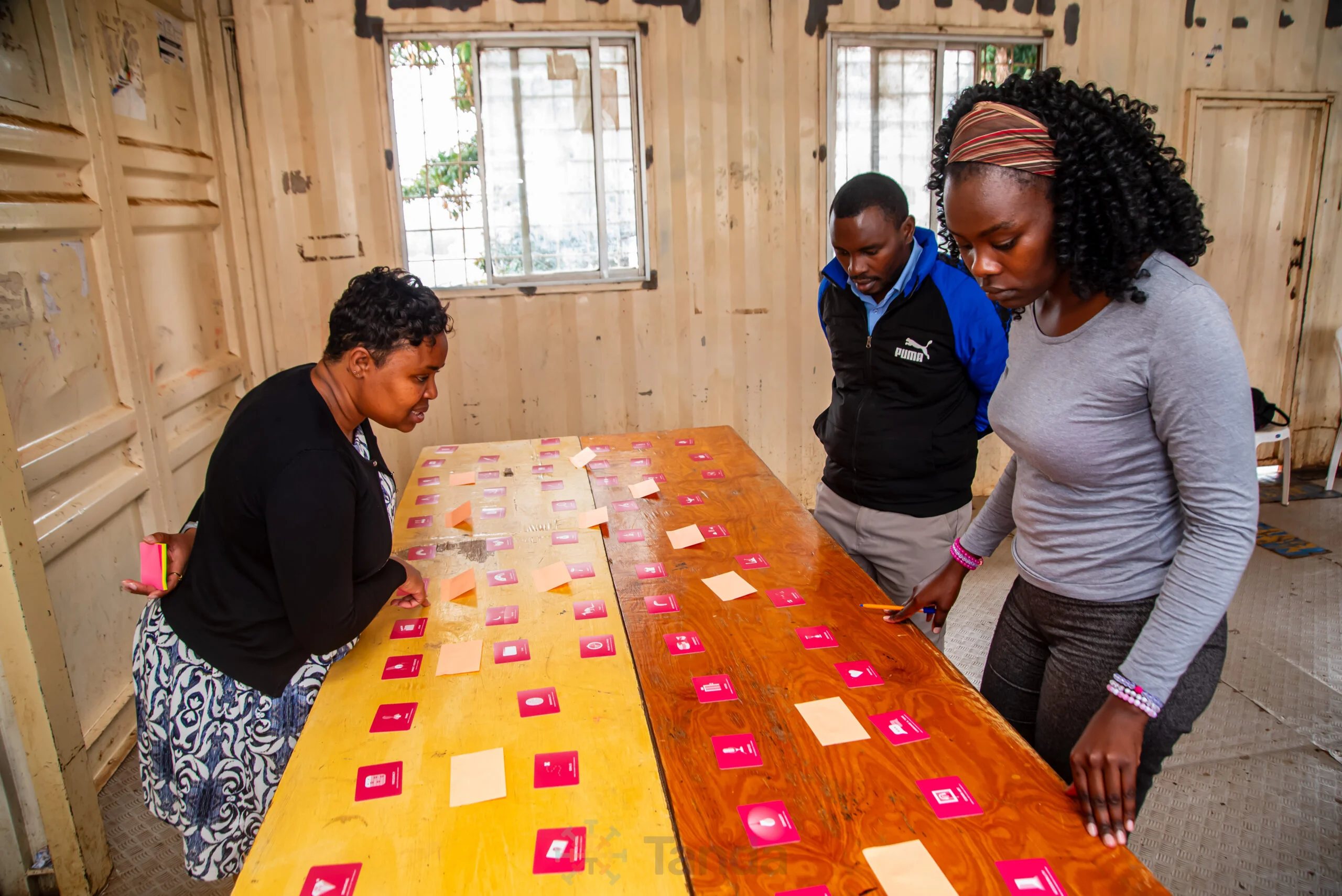
Photo: Irene Mbaya and Lenser Loise at the Tanda Community Network during the first podcast coaching session.
The research findings made it clear that communities such as Kibera experience gaps in connectivity, affordability, and digital access, shaping how they access information and participate in the digital world. We wanted to explore not only how communities are connecting, but also what happens when they have the tools and spaces to create and share content that reflects their own realities.
A podcast felt, and our first day of coaching became a turning point.
We went through the fundamentals of podcast production and, more importantly, began connecting the dots as a team.
Each partner brought a different part of the puzzle. IAWRT was closely involved in the production itself, from sound, editing and hosting to the logistics that kept the team moving.
Tanda Community Network brought the community perspective. Working directly within Kibera, the team understood the context and helped shape the content, refine the scripts, advise on guests, ensure different voices were captured and provide the space where the podcast was recorded and produced.
DW Akademie brought the technical media expertise, coaching and mentorship that helped us strengthen our production skills and provided quality assurance along the way.

Photo: IAWRT and Tanda Community Network teams during the first meet-up.
We tried to create a work plan, a timetable and a structure for the production process. But as the work progressed, one thing became increasingly clear: no plan would work unless we were willing to be flexible and support one another.
Podcast production was not a straight line we had bumps, changes and unexpected challenges along the way.
When the Equipment Arrived
The equipment arrived around Christmas, which meant our festive season suddenly included checking deliveries, unpacking items and making sure we had everything we needed.
At the time, we had envisioned recording the podcast in a natural community setting. The idea was to capture the environment and authenticity of the communities we were documenting.
Our first attempt, however, did not go as planned.
Kibera has its own soundtrack: people, movement, businesses, traffic and everything else that makes a neighbourhood alive. While that atmosphere was important to the story we wanted to tell, it was not ideal for producing clean, professional audio.
Still, the team knew Kibera had to remain our recording site. We did not want to move the podcast away from the community simply because the environment presented a technical challenge.
We upgraded the mixer, improved the microphones and began thinking creatively about the tools already available to us. One of them was Colmena, software designed to support recording in challenging conditions.
Colmena is an offline-first, mobile-friendly, open-source media toolbox designed for local and community content production.
For us, its value became particularly clear in a setting where access to professional recording equipment and reliable internet could be limited. It helped reduce the busy background noise and echo, which made editing our dry run much smoother. At that point, we realised we did not need to change the environment.
Eventually, we created a makeshift studio inside the premises of one of our partners, Tanda, right in the heart of Kibera.
And suddenly, everything clicked. It was not a fancy studio, and it did not need to be.
Bringing More Voices into the Conversation
Not every guest could make it to Kibera. On some days, we brought guests into the studio, set up microphones and recorded the conversations face-to-face. On other days, distance made that impossible, so we used Zoom to bring guests into the conversation and recorded the calls directly through the mixer.
Through the six episodes, we explored different parts of this ecosystem. We started by unpacking what community networks are and why they matter for digital inclusion in Kenya, before looking at local content and the tools communities can use to create and share it. We explored technologies such as Colmena, the role of community radio and partnerships in strengthening local content, and finally the policy and regulatory environment shaping community networks in Kenya.
We also engaged stakeholders working in communication and connectivity, as well as people behind community radio stations and other platforms through which communities share their own stories.
Beyond the Usual Voices
We wanted the podcast to go beyond the obvious voices. The goal was to bring different perspectives into the same conversation and create space for people who are often discussed in policy and research spaces to speak for themselves.
One reflection from our fourth episode captured why these conversations matter. Henix Obuchunju, News Editor at Pamoja Radio, observed, “Traditional media is shrinking, it is really shrinking.”
His observation brought us back to one of the questions running through the series: as the media landscape changes, how can community networks and community radio continue creating spaces for people to produce, access and share information?

Photo: A snapshot of the six-part podcast series as displayed on one of the distribution platform.
By April 2026, Episode Six of Connected Voices had aired, marking the completion of the season we had set out to produce.
What started with research and a podcast coaching session became six conversations about connectivity, local content, technology, media, partnerships and policy.
While the season may have ended with Episode Six, the questions about who gets to create, share and shape information in an increasingly digital Kenya are far from over.
Our greatest learning was that producing a community podcast is about more than getting the technical aspects right. It is about understanding the community, making space for different voices and being willing to adapt when the original plan does not work.
To catch a glimpse of our six-part podcast season click any of the link below:
Spotify: https://open.spotify.com/episode/3WJC4puUrBtdR8DiLDdNjz?si=lEkrTfS3QK-7X4DLWdPLBQ
Afripods: https://afripods.africa/podcast/267ede75-8749-427a-b68c-9a4f94e025a5

Loise Lenser is a freelance journalist who supports organisations to tell stories that highlight their work, impact, and the voices of the communities they serve.
Share this story
Are you a woman working in media?
Join IAWRT Kenya for training, mentorship, fellowships and a supportive network of women media practitioners.
More stories
- All Posts
- Articles
- Mentorship
- Networking

Home › Blog › Articles Protecting Journalists in Kenya’s Digital Space: Why Media and Tech Policy Must Be Rights-Based 18 October 2026...
Home › Blog › Articles Reporting Violations Against Female Journalists: A Shared Responsibility 31 August 2026 4 min read Articles By IAWRT...
Home › Blog › Articles What a Year of Tracking and Mapping Online Gender-Based Violence Against Women in Media Revealed 24 August...