
By Lenser Loise
For over one year, from June 2025 to June 2026, a team of women journalists across Africa documented online gender-based violence targeting women in the media. Their work revealed recurring patterns of harassment, intimidation, repeated attacks and the long fight for accountability.
I was part of a selected team of female journalists from the International Association of Women in Radio and Television (IAWRT) Kenya Chapter, working alongside colleagues from several other African countries conducting the mapping.
To ensure all the regions in Africa were covered, we divided ourselves into four crosses (East, West, North and South). My role involved tracking cases, verifying information, checking in on victims and monitoring what happened after incidents were reported in the 17 western African countries. In situations where the online available information was not sufficient, I did a one-on-one follow-up, conducting over-the-phone interviews to verify developing cases.
I consistently monitored different social media platforms (Facebook, Twitter and Instagram), taking screenshots of incidents, following up on reports and developments around cases that had already been mapped.
There was always a sense that I might miss something: a post could appear at any time, a journalist could suddenly become the target of an online attack, or an incident that began online could quickly turn physical. For the better part of a year, I kept watching, checking, verifying, following up and documenting.
Looking back at the cases I encountered, several patterns began to emerge.
Elections Intensify Online Attacks Against Women Journalists
One of the clearest trends I observed was the link between elections and increased attacks against women in the media. Whenever an election took place in an African country during our monitoring period, cases of targeted online and sometimes physical violence against women journalists and media workers were difficult to miss.
The political environment appeared to create an especially hostile space for female journalists and content creators. Freelance journalists and independent content creators appeared particularly vulnerable because they often lacked the institutional protection available to those working for larger media organisations.
In some cases, the consequences were devastating, including incidents that ended in death, with one record being Mariam Cissé, a TikTok content creator who was killed in Mali after sharing her political views on her page with about 100,000 followers:
Women Behind the Camera Face Risks Too
Another trend that stood out was that OGBV did not only affect women in front of the camera. Women working behind the scenes were also exposed to significant risks.
Camera operators, photographers, producers and other media workers could find themselves directly caught up in political confrontations and attacks. The entire media production chain is exposed
For Some Women, the Attacks Keep Returning
Another pattern that became increasingly visible was the recurrence of attacks. Being targeted once did not always mean the harassment would end.
I observed several instances where women journalists were targeted repeatedly, sometimes months or even years after the original incident.
One case that stood out was that of Nigerian journalist Taiwo Aina Adeokun, who, according to details captured during the mapping exercise, had to lock her social media accounts after repeated attacks following her report on the New York Times Post:
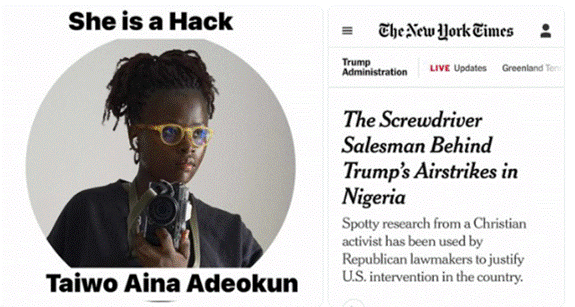
X Screengrab: One of the online narratives that pushed Taiwo to lock her X account on January 19, 2026.
Our mapping showed that the risk does not always disappear. For some women, the internet remembers, and harassment can return whenever a new event brings their name or previous work back into public attention.
Justice Can Be Slow, but Progress Is Possible
When I began the mapping exercise, many of the cases we encountered appeared to be stuck. There were complaints with no visible progress, slow-moving investigations and victims who had been waiting for justice for long periods.
Toward the end of our monitoring period, however, I began to see movement in some cases.
In others, international organisations continued to raise concern, including the Committee to Protect Journalists, which urged the release of Tunisian journalist Chadha Hadj Mbarek over health concerns.
Those developments mattered to us as a team. For months, I had been watching these cases, following updates and checking whether anything had changed. Seeing a case move forward was more than another database update; it was a reminder that persistence can matter.
How X Became a Key Monitoring Tool
Throughout the mapping exercise, X played an important role in helping me identify and monitor cases. As a platform built around real-time public conversation, it allowed us to see some incidents as they unfolded, but verification of sources was still mandatory.
Citizens could report incidents from different parts of Africa, sometimes before those incidents appeared in mainstream media. In some instances, I identified and verified cases before they gained wider public attention.
This made the platform particularly useful for my work. It allowed me to monitor conversations across countries without physically travelling to each location. For a team working across different parts of Africa, that access was invaluable.
During quieter news periods, the number of cases we encountered generally reduced. But for journalists like me, this was an important distinction: a quiet news cycle does not necessarily mean women journalists are safe. It means monitoring must remain intentional.
Report a case today on IAWRT’s observatory via report.iawrt.or.ke.

Loise Lenser is a freelance journalist who supports organisations to tell stories that highlight their work, impact, and the voices of the communities they serve.
Share this story
Are you a woman working in media?
Join IAWRT Kenya for training, mentorship, fellowships and a supportive network of women media practitioners.
More stories
- All Posts
- Articles
- Mentorship
- Networking

Home › Blog › Articles Protecting Journalists in Kenya’s Digital Space: Why Media and Tech Policy Must Be Rights-Based 18 October 2026...
Home › Blog › Articles Reporting Violations Against Female Journalists: A Shared Responsibility 31 August 2026 4 min read Articles By IAWRT...
Home › Blog › Mentorship Media Observatory – Challenges And Prospects 21 August 2026 2 min read Mentorship By William Okech, OGW. ...