
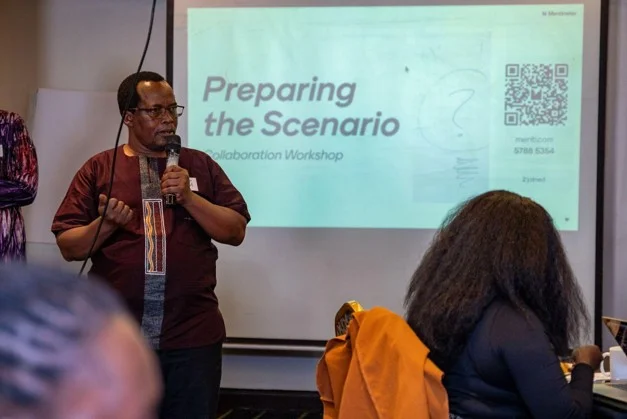
Photo: Kenya Correspondents Association’s William Oloo Janak sets the stage for discussions on collaborative strategies among media support organisations on election preparedness and safety at a recent meeting in Nairobi.
By Nelly M. Nyangorora
NAIROBI — Concerns about journalist safety and press freedom are intensifying in Kenya as political tensions rise ahead of the election.
At a roundtable convened by the Supporting African Future Investigative and Responsible Journalism (SAFIRI) consortium, media support groups in Kenya discussed collaborative strategies to strengthen journalist protection and support a safer environment for election coverage.
The SAFIRI Consortium, which promotes ethical and responsible journalism, brought together the International Association of Women in Radio and Television (IAWRT), the Media Council of Kenya (MCK), the Kenya Correspondents Association, AMWIK, Journalists for Human Rights, Africa Uncensored, and other groups to explore ways to help ensure election coverage takes place in a safe and free environment.
Safety, information integrity, legal support and literacy, early warning, election reporting skills, and psychosocial support were the forum’s main focus areas. Partners from Free Press Unlimited and Aspen, a global nonprofit focused on democracy, leadership, technology, and social change, also attended.
There were calls to link accreditation with insurance cover and to ensure media houses take greater responsibility for journalists accredited and deployed to cover high-risk assignments.
MCK said journalists accredited by media houses to cover the election must have insurance.
“The policy requiring a protection plan for all journalists deployed to high-risk areas is in place. Journalists assigned to such areas should ensure it is implemented,” said Rebecca Mutiso, MCK’s acting manager for press freedom and advocacy.
The organisations discussed their individual strengths and how these could be leveraged to build protection and resilience mechanisms that enhance journalists’ safety.
IAWRT Kenya’s violations-mapping tool addresses the critical issue of safety by helping document violations, map risks, anticipate attacks, and serve as an early warning system.
IAWRT is working with women journalists, law enforcement officers from Kenya, Uganda, Nigeria, Zambia, Cameroon, and other countries, as well as the Pan African Lawyers Union (PALU), to turn documentation of violations into coordinated early warning, rapid response, and long-term protection.
As the election cycle beckons, reports indicate rising threats to journalists. Amnesty International’s May report points to a growing pattern of harassment, obstruction, and physical attacks against journalists covering political and public events between February and May 2026.
The violence during the July 2026 election in Ol Kalou further suggests that the environment remains volatile. Journalists were among those targeted during the electoral process, with at least 10 reportedly attacked by armed groups.
In 2023, demonstrations in Kisumu saw more than 25 journalists assaulted or robbed of equipment, an early warning indicator for the 2027 election.
Kenya Correspondents Association’s Oloo Janak said all indications suggest the election will be volatile.
“We can clearly see from reports how challenging the reporting environment is. The rhetoric from politicians is dominated by slogans rather than issue-based conversations. Journalists who have never covered an election are likely to be deployed to report on these polls amid emerging challenges. We need strategies in our different spaces to address information integrity and the safety of journalists,” he said.
The election date is already contested and mired in confusion following a 7 August 2026 court ruling in Malindi. The ruling raised a constitutional question over whether the election cycle should have been concluded by 11 August 2026, even as the IEBC has formally confirmed 10th August 2027 and included it in its election operations plan.
Justice Mugure Thande, however, suspended the declaration’s effect until after the polls to allow time for appeals and avoid disruption.
This context already presents an information integrity challenge and creates uncertainty, particularly around the outcome of the appeal and the response of political parties, candidates, and voters.
These scenarios create a difficult reporting environment for journalists covering the election. The atmosphere is already politically charged, increasing the risk of misinterpretation, speculation, and disinformation spreading quickly. By all indications, the 2027 polls are likely to test the media’s resilience, making coordinated prevention and response measures across the sector an urgent priority.
These circumstances show why election preparations must begin well before polling day.
Monitoring violations in real time
The platform, accessible at report.iawrt.or.ke, is a real-time monitoring and reporting tool developed in partnership with UNESCO’s International Programme for the Development of Communication (IPDC). It was built by the Kenya ICT Action Network (KICTANet) using Ushahidi’s crowdsourcing technology.
Launched in August 2025 as the second phase of a multi-year initiative, the platform allows journalists and witnesses to log incidents, tag locations, categorise threats from harassment and censorship to physical and sexual violence, and attach supporting evidence.
IAWRT’s monitoring tool is framed around seven strategic pillars for a safe reporting environment: institutionalising safety mechanisms, investing in digital resilience, building rapid response networks, strengthening inter-agency coordination, countering gendered disinformation, reforming legal frameworks, and changing norms through solidarity.
IAWRT has been training women journalists across all 47 counties in digital safety and AI verification. By March 2026, about 50 women journalists had received the training through a partnership with the Google News Initiative.
PALU’s Kenyan representative, Lawyer William Oketch, says the observatory tool is essential as it provides documentation for legal action, calling for greater awareness of its existence and urging journalists whose rights have been violated to allow litigation.
“Female journalists are reluctant to pursue litigation due to subtle coercion, intimidation, and discouragement from their own employers, a gross act of impunity by employers”, he said in a statement.
As Kenya moves toward another high-stakes election, the mapping platform offers more than a record of violations: it gives media support organisations a shared evidence base to spot emerging threats, coordinate rapid responses, and strengthen protections for women journalists before risks escalate on the campaign trail and at the polls.

Nelly Moraa Nyangorora is an independent editor, journalist, and Ethics and Responsible AI (ERAI) Fellow with more than 28 years of experience in journalism, communications, and public policy.
She is a former Chief Parliamentary Editor at the Kenya Broadcasting Corporation (KBC), where she pioneered live commentary of parliamentary proceedings under Kenya’s Parliamentary Broadcast Unit, building extensive expertise in legislative and policy reporting.
She holds a postgraduate qualification in Reporting Climate Change from Università Telematica Internazionale UNINETTUNO, Italy, and writes on the intersection of artificial intelligence, climate, health, governance, and digital rights.
Share this story
Are you a woman working in media?
Join IAWRT Kenya for training, mentorship, fellowships and a supportive network of women media practitioners.
More stories
- All Posts
- Articles
- Mentorship
- Networking

Home › Blog › Articles Protecting Journalists in Kenya’s Digital Space: Why Media and Tech Policy Must Be Rights-Based 18 October 2026...
Home › Blog › Articles Reporting Violations Against Female Journalists: A Shared Responsibility 31 August 2026 4 min read Articles By IAWRT...
Home › Blog › Articles What a Year of Tracking and Mapping Online Gender-Based Violence Against Women in Media Revealed 24 August...