By Caroline Gachacha
Reporting Violations Matters
Recent incidents in Kenya and Sudan demonstrate the continuing risks faced by women journalists and the importance of documenting violations against media workers.
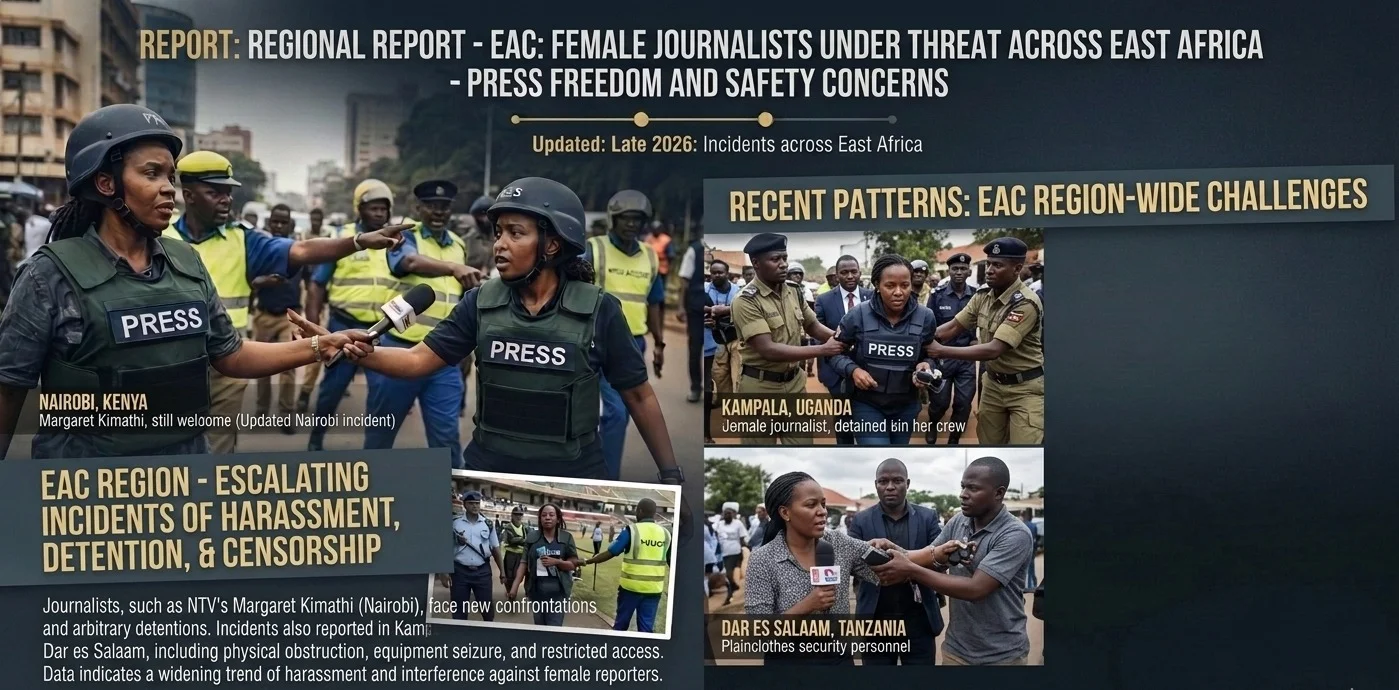
The cases range from harassment, intimidation, arbitrary detention, restricted media access, and interference with journalists while covering public events in Kenya, Uganda, and Tanzania to the detention and disappearance of women journalists in Sudan, Ethiopia, Congo, Burundi, and across Africa.
For organizations working to protect journalists, documenting each incident is important not only to establish what happened, but also to identify patterns, pursue accountability, and ensure that cases do not disappear without follow-up.
Concerns over the Safety of Women Journalists
The safety of women journalists is a rising concern that directly infringes on press freedom.
In Uganda, women journalists find themselves in quite a restrictive environment, facing threats that escalate significantly during election cycles and around political events.
The high-profile incident involving Susan Nsibirwa, managing director of Nation Media Group Uganda, where she has continually faced intimidation, points to the gendered hazards women executives in media face while steering their organisations through political crises/events.
Uganda’s Chief of Defence Forces (CDF), General Muhoozi Kainerugaba, ordered the NTV Uganda shut down.
The military surrounded the station, forcing NTV Uganda, Spark TV, the Daily Monitor, and KFM radio off the air.
General Muhoozi targeted Nsibirwa on X, referring to her as a “small girl” who needed to be disciplined, calling for her arrest on sight.
NTV Journalist Margaret Kimathi was recently accosted by police while covering Saba Saba protests. She was physically harassed and forced to delete footage while filming barricades at Allsops in Nairobi, and her equipment was confiscated briefly. From her Facebook post, she narrated her ordeal under the officers who described her as a novice.
Another case was that of sports journalist and Sports Eye Media founder Ruckiel Odikor, popularly known as Rix.
According to NTV Kenya, Odikor was forcibly removed from Nyayo National Stadium on 15 February 2026 while covering the HSBC SVNS 2 rugby tournament. CCTV footage showed security personnel escorting her from the stadium. NTV reported that Odikor had covered the same section of the stadium the previous day without incident.
The Sports Journalists Association of Kenya (SJAK) condemned what it described as the physical handling and intimidation of a member. SJAK said it had engaged Odikor, the event organisers, the Kenya Rugby Union (KRU) and relevant security agencies to establish the facts and safeguard the journalist.
KRU subsequently said the confrontation occurred after Odikor allegedly entered a restricted area near the track and medical zone without the required accreditation clearance. At the same time, the union said it did not condone excessive force and said it was investigating the incident and reviewing stadium security procedures.
The Kenya Editors’ Guild (KEG) also condemned the incident and called for an investigation, public disclosure of the findings, appropriate disciplinary action against those responsible and clearer safeguards for journalists covering sporting events.
Sudan: Detention and Disappearance of Women Journalists
The situation in Sudan is considerably difficult.
According to the Committee to Protect Journalists (CPJ), the Rapid Support Forces (RSF) detained Nyala State Radio journalists Mawaheb Ibrahim, Zahraa Muhammad Al-,Hassan and presenter Ishraqah Abdulrahman in Nyala, South Darfur, on 28 February 2026.
CPJ reported that the three women were transferred to Korea prison and were being held without formal charges or being brought before a court.
The Sudanese Journalists Syndicate (SJS) separately raised concerns about the arbitrary detention and enforced disappearance of journalists in Sudan. In March, the syndicate said it had documented cases involving journalists in Khartoum, Darfur, and Sennar, including the detention of women journalists in Nyala and their transfer to Korea prison.
Latest update on the three Nyala journalists
There has since been a significant development.
On 30 July 2026, CPJ renewed its call for the immediate release of Ishraqah Abdulrahman, Zahraa Muhammad Al-Hassan,-Hassan and Mawaheb Ibrahim, saying their health had reportedly deteriorated during their detention.
CPJ said a member of the Sudanese Journalists Syndicate, speaking anonymously because of fear of reprisals, told the organisation that families had received information from women recently released from detention.
According to that account, the three journalists had lost significant amounts of weight and were suffering from fever and other untreated health complications because of a lack of medical care.
CPJ said it contacted the RSF through its website but did not receive a response.
No public response from the RSF addressing the specific allegations about the journalists’ health or confirming their release was identified in the sources reviewed as of 12 August 2026.
There was also a broader development concerning Korea Prison in Nyala. Darfur24 reported on 9 June that more than 27 female detainees had been released following a review of detention cases involving representatives of the judiciary, prosecution, police, RSF intelligence, and the RSF legal advisory office.
However, the report specifically said that the whereabouts of five female journalists and activists arrested in connection with a women’s workshop remained unknown, including Ishraqah Abdulrahman, Zahraa Muhammad Al-Hassan and Mawaheb Ibrahim.
This means the article should not state simply that all women detained at Korea Prison were released. The evidence indicates that some detainees were released, while the three journalists remained a matter of concern.
In Tanzania, the Committee to Protect Journalists and other human rights reports indicate similar threats. In January 2025, prominent Tanzanian journalist Maria Sarungi Tsehai was abducted in Kenya in a cross-border surveillance operation. CPJ’s Africa Program Coordinator Muthoki Mumo described the incident, expressing fear that Kenya, previously regarded as a safe haven, was becoming hostile to those with dissenting opinions.
“ Authorities in Kenya must ensure those responsible for Maria Sarungi’s abduction are held accountable,” she said.
Sarungi publishes commentary on Tanzania politics on her social media platforms. She fled Tanzania in 2023 following threats of arrest and the banning of her media outlet.
Tanzania October 2025 election, according to the Collaboration on International ICT Policy for East and Southern Africa CIPESA May 2026 report, witnessed increased attacks that included arrests of Journalists like Janeth Rithe, and digital spaces were weaponised to silence women reporters covering hard politics.
From Documentation to Accountability: The IAWRT Observatory
The cases across East Africa and beyond demonstrate why systematic documentation of violations against women journalists is necessary.
The International Association of Women in Radio and Television (IAWRT), working with UNESCO’s International Programme for the Development of Communication, developed an online observatory to monitor and document violations against women journalists across Africa.
The platform allows incidents to be mapped, categorized, and supported with evidence.
IAWRT has described the initiative as a mechanism for moving from documentation towards action.
In its second phase, the organization brought together journalists, law enforcement officers, legal experts and media stakeholders to strengthen mechanisms for responding to reported violations.
IAWRT has also partnered with the Pan African Lawyers Union (PALU) to strengthen the legal component of the initiative.
According to IAWRT, PALU’s role includes providing legal guidance to journalists, supporting litigation and helping ensure that institutions respond to verified cases submitted through the mapping mechanism.
The observatory is therefore intended to serve two connected purposes: first, to build a credible evidence base showing the nature and scale of violations against women journalists; and second, to use that evidence to support advocacy, legal intervention and engagement with relevant stakeholders.
Every Incident Needs To Go On Record
The cited cases demonstrate why incidents affecting journalists should not be dismissed as isolated workplace confrontations.
There were reports that the Ugandan state had indicated an overhaul of the editorial structure as a condition for reopening NTV Uganda, but Susan Nsibirwa is back in her position and resolute as she was before to uphold the core editorial values and policy.
On August 6th, 2026, she led a staff meeting when the station that had been closed resumed operations, restoring broadcasts and newspaper circulation.
The state-backed assault on Nsibirwa reveals how political actors employ misogyny, weaponised isolation, and professional minimisation to break the resolve of female media leaders.
The Margaret Kimathi incident, where she was forced to delete footage at a barricade and her expertise was questioned, reflects how patriarchy and institutional power entrench gender bias. While state security forces target all journalists to intimidate them and infringe press freedom, female journalists face a unique, gendered layer of hostility that devalues their professional authority.
The rugby case shows how a disagreement over accreditation or access can escalate into physical handling of a journalist. The subsequent engagement by SJAK, KRU and other stakeholders demonstrates the importance of documenting the incident and pursuing institutional follow-up.
The Sudan cases demonstrate an even more serious risk: journalists can be detained for prolonged periods, lose contact with their families and face serious health consequences while in custody.
Across Africa, like in Ethiopia, Congo, Zambia, Nigeria, and Uganda, incidents reported reflect a pattern that points to increased attacks against women journalists. The mapping tool provides structured documentation exposing these hidden patterns that enhance institutional accountability.
IAWRT and UNESCO’s partnership in keeping women journalists safe provides evidence that gender based attacks follow a predictable trajectory.
Combating impunity relies on verifiable legal evidence.
CPJ’s July 2026 update confirms that continued documentation can keep such cases in the public domain even months after the initial detention.
Journalists are therefore encouraged to report incidents of assault, harassment, intimidation, threats, detention, disappearance, obstruction, online abuse, sexual harassment or any other violation they experience or witness against another journalist.
IAWRT Observatory link: https://report.iawrt.or.ke

Caroline Gachacha Mucheru is a veteran media executive and award-winning broadcaster boasting a rich, two-decade career in the radio industry.
As a Senior Producer and the Head of the KBC English Service at the Kenya Broadcasting Corporation (KBC), she strategically steers programming, content creation, and broadcast operations for one of the country’s premier frequencies.
Alongside her leadership role, Caroline leverages her extensive background as a communication specialist and media trainer to drive broadcast innovation and excellence across the region.